Frida Kahlo: The Artist Who Made Self-Portraiture Political
Thirty. That is roughly how many operations Frida Kahlo went through in her lifetime, according to the biographers and doctors who have tried to count them. Spinal fusions, bone grafts, a corset made first of plaster, then steel, then leather, fitted to a spine a steel handrail had shattered when she was eighteen. Most of her paintings were made in the gaps between those operations, propped up in bed, looking into a mirror her mother had installed on the canopy above her.
On September 17, 1925, the wooden bus Kahlo was riding collided with a streetcar in Mexico City. A handrail went through her pelvis. Her spine broke in three places, her collarbone and several ribs snapped, her right leg fractured in eleven places, her right foot was crushed. She was not expected to walk again. She spent three months in a full-body cast and began painting to fill the hours, using a specially built easel that let her work lying flat on her back.
Of the roughly 200 paintings she made before her death in 1954, art historians count about 55 as self-portraits. "I paint self-portraits because I am so often alone, because I am the person I know best," she said. Read on its own, that sounds like a private habit. Looking at the actual paintings, it reads as something closer to a political practice, repeated for thirty years.
Why the Tehuana dress was not just an outfit
Kahlo rarely painted herself in ordinary clothes. Again and again, she wears the long, embroidered skirts and huipils of the Tehuana women of Oaxaca, a matriarchal Zapotec culture that predated Spanish colonization. Mexico in the 1920s and 30s was rebuilding a national identity after its revolution, and a lot of that rebuilding ran through art. Diego Rivera painted murals reclaiming Indigenous and mestizo history on the walls of government buildings. Kahlo did something quieter but just as pointed: she put that same reclaimed identity on her own body, in her own mirror, and then on canvas.
Her mother was mestiza, her father a German-Jewish immigrant. Choosing the Tehuana dress, again and again, was not neutral. It was a stated allegiance, painted onto the one subject she had constant access to.
The paintings nobody else was making
In 1932, while living in Detroit with Rivera, Kahlo miscarried. She painted Henry Ford Hospital that same year: herself on a hospital bed, naked, bleeding, tethered by red cords to a fetus, a snail, a pelvis, a machine part, all floating around her like medical debris. Nobody was painting female reproductive loss like that in 1932. It was not decorative and it was not abstracted into metaphor. It was clinical and it was hers.
Twelve years later, after yet another spinal surgery, she painted The Broken Column: her torso split open, an ancient, crumbling Ionic column standing in for her spine, nails driven into her bare skin, tears on her face but her expression otherwise flat. A body in pain, shown as architecture failing. Disability as subject matter, decades before that was a recognized category in art criticism at all.
By the end of her life she had folded her body's story into her political one directly. Marxism Will Give Health to the Sick (1954), painted the year she died, shows her dropping her crutches, held upright by a giant hand emerging from a Communist dove. She had rejoined the Mexican Communist Party in 1948. The painting is not subtle, and it was not meant to be.
/imag

A marriage that ended up on canvas too
Kahlo married Rivera in 1929, divorced him in 1939, and remarried him in 1940. In between, he had an affair with her younger sister Cristina. She had her own affairs, reportedly including one with Leon Trotsky, who lived with the couple at the Casa Azul, their cobalt-blue house in Coyoacán, in 1937.
The Two Fridas (1939), painted around the divorce, shows two versions of her seated side by side, hands joined, hearts exposed and connected by a single vessel of blood. One Frida wears a white European-style dress, heart cut open and bleeding. The other wears Tehuana dress, heart intact. It is a breakup painting and an identity painting at the same time, which is more or less how Kahlo worked. The personal and the political were never separate categories for her. They were the same canvas.
What still lands
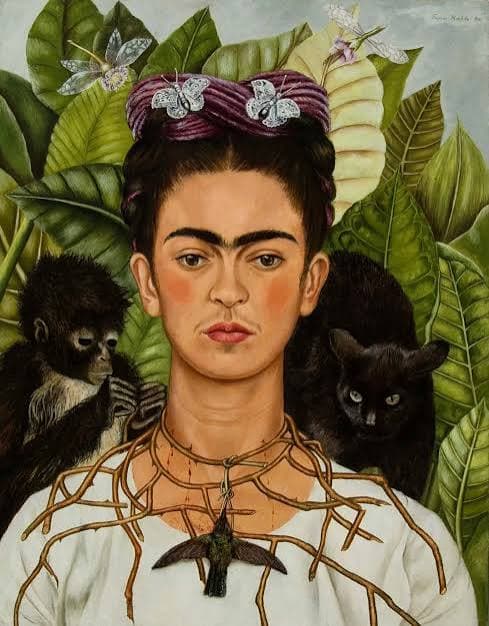
Museo Frida Kahlo, the Casa Azul where she was born, lived, and died, is a smaller building than most visitors expect walking up to it. Several of her self-portraits are physically small too. Self-Portrait with Thorn Necklace and Hummingbird measures 63.5 by 49.5 centimetres, roughly the size of a large kitchen window. That gap, between how monumental the paintings feel in reproduction and how intimate they actually are at real scale, is part of why people plan trips around seeing them in person (or, short of a flight to Mexico City, at least look up the real dimensions before deciding where a print of one might hang).
Thirty operations. Fifty-five self-portraits. One artist who decided that painting her own face, over and over, was not self-indulgence. It was the most direct way she had to argue that a body in pain, a woman's body, an Indigenous-identified body, belonged in the political conversation, not just the medical one.
FAQ
Why did Frida Kahlo paint so many self-portraits?
Kahlo painted around 55 self-portraits out of roughly 200 works, largely because long recovery periods after her 1925 bus accident kept her confined to bed with a mirror as her main available subject. She herself said she painted her own face because she knew it best.
What happened to Frida Kahlo in her bus accident?
On September 17, 1925, a bus she was riding in Mexico City collided with a streetcar. A steel handrail impaled her pelvis, her spine broke in three places, and her right leg and foot were badly crushed, leading to an estimated thirty operations over the rest of her life.
Is Frida Kahlo's art considered political?
Yes. Her repeated use of Tehuana dress asserted Indigenous Mexican identity after the Mexican Revolution, and later works like Marxism Will Give Health to the Sick directly reflected her Communist Party membership, making her self-portraits a form of political statement rather than simple self-documentation.
Where can you see Frida Kahlo's paintings today?
The largest single collection is at the Museo Frida Kahlo (Casa Azul) in Coyoacán, Mexico City, her family home. Other major works, including several self-portraits, are held by museums such as MoMA in New York and the Harry Ransom Center in Texas.