Yayoi Kusama: Infinity, Obsession, and the Art of Repetition
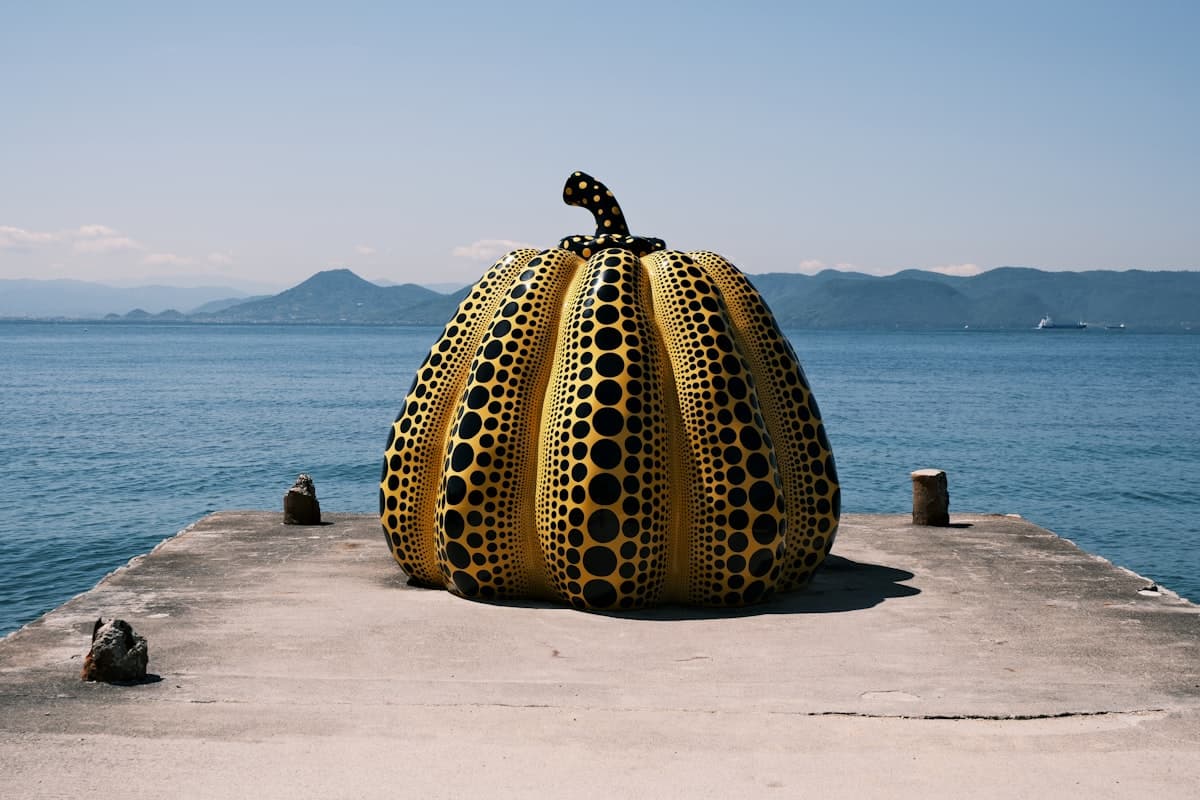
Ninety-seven. That is how old Yayoi Kusama is now, and she still goes to her studio most days, painting dots onto canvas in a building a short walk from the Tokyo hospital she has lived in, by her own choice, since 1977.
Most artists slow down. Kusama has had, by her own account, the opposite problem: the visions never stopped, and neither did the need to paint them.
She was ten years old in Matsumoto when the hallucinations started. Flowers on the tablecloth spoke to her. A field of violets looked up and had faces. Dots crept across the walls, the ceiling, her own hands, until the boundary between her body and the room dissolved. She has described this feeling for decades with one recurring word: obliteration. Not fear of it. A kind of relief.
Her family ran a plant nursery and seed farm, and expected her to marry into a similarly respectable life. Instead she left for New York in 1957 with a suitcase of kimonos she planned to sell, sewed money into the lining of her clothes because Japan's currency controls barred her from taking cash out of the country, and spent the next fifteen years building a career in a scene that had little interest in a Japanese woman painter. She got there anyway. Her "Infinity Net" paintings, canvases covered edge to edge in small looping brushstrokes with no obvious centre or end, drew comparisons to Abstract Expressionists twice her fame and half her discipline. Museums including the Tate now hold her early nets in their permanent collections. Donald Judd, her neighbour on East 19th Street, bought one before the two artists had properly met.
The nets and the dots are the same idea painted two ways. Both refuse to resolve into a single focal point. Stand close to an Infinity Net canvas and there is no "best" place to look, no composition guiding your eye toward a climax. The pattern just keeps going, past the edge of the frame, implying a field that never ends. That is the entire point. Kusama has said the polka dot has "the form of the sun" and "the form of the moon", both round, both eventually reducing everything, including the self, to the same repeating shape.

By the mid-1960s she had turned the idea into rooms. The first Infinity Mirror Room, built in 1965, lined a small chamber with mirrors and filled the floor with hundreds of soft phallic sculptures covered in the same red polka dots. Stand inside and your reflection multiplies into a crowd that recedes forever in every direction. It is not really a metaphor for infinity. It is closer to what she described feeling as a child: the self, mass-produced into nothing, dissolved into the pattern around it.
That idea has aged into one of the most photographed experiences in contemporary art. When the Hirshhorn Museum in Washington DC staged "Infinity Mirrors" in 2017, demand was high enough that visitors were given roughly 20 to 30 seconds per room, and the museum still had to run timed tickets for months. There is something almost funny about a piece built around self-obliteration becoming the backdrop for millions of individual selfies, each one insisting: I was here, this is me. Kusama, who has spent her career trying to paint herself out of existence, ended up building one of the most photographed "I exist" machines in modern art.
Seeing that work in a photo and seeing it in the room are not the same experience, and this is one of the rare cases where that gap is the entire subject of the piece. A photo of an Infinity Net painting reads as a flat, evenly textured surface. In person, at full scale (some of her canvases run several metres wide), the accumulated brushwork has a slight physical relief, thousands of small decisions stacked on top of each other over hours. A photograph of a photograph loses that entirely. It is the same reason a print of any large-scale painting looks smaller and flatter on a screen than it does taking up real space on an actual wall, dots or no dots. It's part of why Blenda exists: so a buyer looking at a piece online can at least preview it at real size on their own wall, instead of guessing from a flat square on a screen.

Photo by Scott Greer on Unsplash
Kusama checked herself into Seiwa Hospital for the Mentally Ill in 1977, after a decade back in Japan that she has described as lonely and professionally difficult following her return from New York. She never checked out. She still works daily in a studio nearby, and has said plainly that making art was never a career choice so much as the only treatment that has worked: "I fight pain, anxiety, and fear every day, and the only method I have found that relieves my illness is to keep creating art."
That line reframes the whole body of work. The dots were never a motif she picked off a shelf. They were the terms she was given, and seventy years of Infinity Nets, mirror rooms, and yellow pumpkins are the record of her negotiating with them, one canvas at a time.
Ninety-seven years old, and the negotiation is still open.
FAQ
How old is Yayoi Kusama and is she still making art?
Yayoi Kusama was born on March 22, 1929, in Matsumoto, Japan, making her 97 as of 2026. She still paints most days in a studio near the Tokyo hospital where she has lived since 1977.
Why does Yayoi Kusama live in a psychiatric hospital?
Kusama has experienced hallucinations, including visual and auditory episodes involving dots and repeating patterns, since childhood. She voluntarily admitted herself to Seiwa Hospital for the Mentally Ill in Tokyo in 1977 and has said that making art in a studio nearby is what keeps her symptoms manageable.
What do Yayoi Kusama's polka dots mean?
For Kusama, the polka dot represents both the sun and the moon, and a way of dissolving the self into an endless, repeating pattern. She has described the feeling behind the dots as "self-obliteration": the boundary between her body and her surroundings disappearing.
Where can you see a Yayoi Kusama Infinity Mirror Room?
Infinity Mirror Rooms are held in the permanent or touring collections of museums including the Hirshhorn Museum in Washington DC, Tate in London, and several institutions across Japan, though availability changes often and usually requires timed tickets due to demand.