The Instagram art aesthetic, and why it's a sales problem
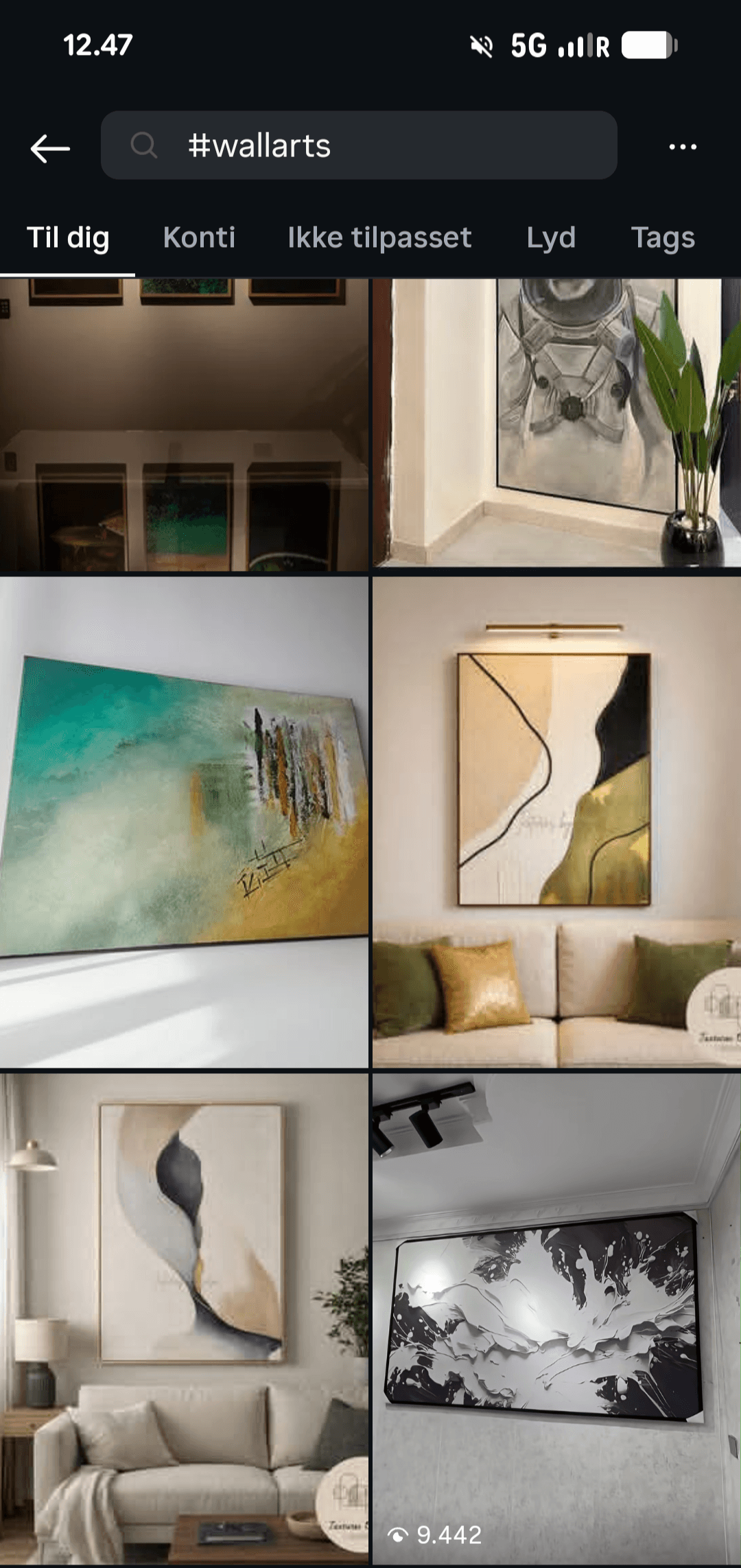
Try a small experiment.
Open Instagram. Search #wallart. Scroll for 60 seconds without stopping. Close the app. Try to remember one specific piece.
You probably can't. Maybe a colour (we're guessing beige), maybe a mood, but not a painting. And it isn't because the work was bad. There were probably a hundred good pieces in that minute. The problem is that they were all shown through the same filter.
Not an Instagram filter. Something more fundamental.
Instagram has a style. Artists have just adapted to it.
This isn't a complaint about social media. It's an observation about a format.
An Instagram image is square (or 4:5, if you're ambitious). It gets seen on a screen roughly six inches wide, for five seconds, while someone waits for coffee. And it competes with a thousand other images for the same glance.
A format with constraints that tight produces an aesthetic. That's not a criticism of artists, it's maths. When the reward system is likes and reach, and reach comes from working in that specific format, the work adapts. Compositions get more symmetrical, because asymmetry has to work harder in a square. Backgrounds become white walls, because white walls are the lowest common denominator.
And the worst part: scale disappears. A 30×30 cm painting and a 200×150 cm major work show up as exactly the same image on the screen. Both are a square on a phone.
And then there are the scenes
There's a new layer on top of all this, and it's made the problem worse.
In the past few years, a wave of tools has appeared that lets artists and galleries drop their work into "rooms." AI-generated living rooms. Generic mockup backgrounds. 3D-rendered apartments with perfect lighting. The idea is a good one: show the buyer what the piece looks like in someone's home. Even we've written about it before
The problem is, it's always the same someone's home.
It's almost always the same living room. Pale wood floor. Beige or grey sofa. A single potted plant to the right. A large window casting soft side light. Maybe a small coffee table with a cup on it. No people. No mess. No personality.
It's become so recognisable you can spot it in a split second. It isn't a living room - it's the scene living room. And when a thousand artists around the world post their work in the exact same scene living room, the work disappears into itself.
The original point of showing a piece in a room was to give the buyer context - to help them imagine the piece in their own home. A generic AI scene does the opposite. It strips out the context that matters (the buyer's room, their light, their furniture) and replaces it with a context that belongs to no one.
It's not about pixels. It's about what can't be seen.
There's a story from the early 2010s, when galleries began noticing that the pieces selling well online weren't always the pieces they'd have prioritised in a physical show. Something had shifted in the relationship between work and buyer.
What had happened? Buyers hadn't seen the work. They'd seen pictures of the work.
That sounds trivial, but it isn't. A painting and a picture of a painting are two different objects. A painting has scale, texture, real colour, a presence in space. A picture has composition, light, and a format. When the buying decision moves from the first to the second, it changes which pieces win.
Instagram isn't responsible for this. But Instagram is the biggest accelerator art has ever had, and it accelerates in one direction: toward what looks good as an image. The AI scenes push it one step further - toward what looks good as an image in a generic living room.
What it costs artists
For an individual artist, the pressure is subtle but constant. You post two pieces. One gets 40 likes. The other gets 400. Over time, even if you don't consciously think about it, the practice drifts toward what gets 400.
That isn't selling out. It's human. Feedback loops shape all behaviour, and Instagram's feedback loop is faster and more quantifiable than anything artists have ever encountered.
But something else happens too: work that doesn't function as an image gets underrepresented in your own archive. Large pieces, texture-heavy pieces, pieces that depend on physical presence - they still exist, but they don't really exist online. And if a piece doesn't exist online in 2026, it barely exists at all. That's an unfair premise. It's also the premise.
What it costs galleries
For galleries, the problem runs the other way: reach goes up, conversion goes down.
A gallery with 30,000 followers wouldn't have existed in 1995. That's an enormous amount of reach. But ask any gallery how many sales come directly from an Instagram post, and the answer is usually underwhelming. People like. They save. They tag a friend. Very few go from a like to a £4,000 purchase.
Why not? Because they don't know what they're looking at. They can't see the scale. They can't imagine the piece in their own room - and the AI-generated mockup room the gallery has attached doesn't help, because it isn't the buyer's room. The price feels abstract, because the work itself feels abstract. It's a picture, not an object.
Instagram has become a brilliant discovery tool and a mediocre sales tool. That's not a paradox. Those are two different jobs, and the platform is built for one of them.
What galleries and artists who actually sell do differently
This is the constructive part. It's also where the post stops being an observation and starts being useful.
The first thing they do: make scale explicit. The work hung in a room with people in it. Measurements in the image itself, not just in the caption. It sounds trivial. It's one of the biggest frictions buyers hit, and most posts ignore it entirely.
The second: video over stills. A 15-second video where the camera moves across a piece shows texture, brushwork, and depth of colour in a way a still image can't. Reach tends to be higher on video too. It's a free upgrade.
The third, and this is where it starts to look like actual sales work: move the decision off the feed, and off the generic scene. Instagram is where the buyer finds the piece. The purchase itself needs a different environment. Not an AI-rendered room that looks like every other AI-rendered room - but the buyer's room, their light, their wall. At real size. That's the only context that actually matters for the decision.
It isn't the art that looks the same
Try the experiment again, with slightly different eyes.
Scroll the same feed. Notice what you're actually seeing. It isn't the work that's become uniform. It's the glass you're seeing it through - a small, bright, square piece of glass that stays the same no matter who's holding it.
The work is still there. Most of it just needs to be seen somewhere else.

FAQ
Why does so much art on Instagram look the same?
Because the feed rewards what reads clearly at thumbnail size: high contrast, one subject, trending palettes. Artists aren't copying each other so much as adapting to the same metric.
Is Instagram good for selling art?
Good for reach, weak for conversion. A like costs nothing and says nothing about whether someone would live with the piece. The sale happens where a buyer can judge scale and presence, and a phone-sized square can't carry either.
How can an artist stand out on Instagram?
Treat the feed as the doorway, not the gallery. Show process, show yourself next to the work for scale, and give followers a way to take a piece home virtually; the grid gets them curious, the wall closes.