Why that painting looked perfect in the gallery (and wrong in your living room)
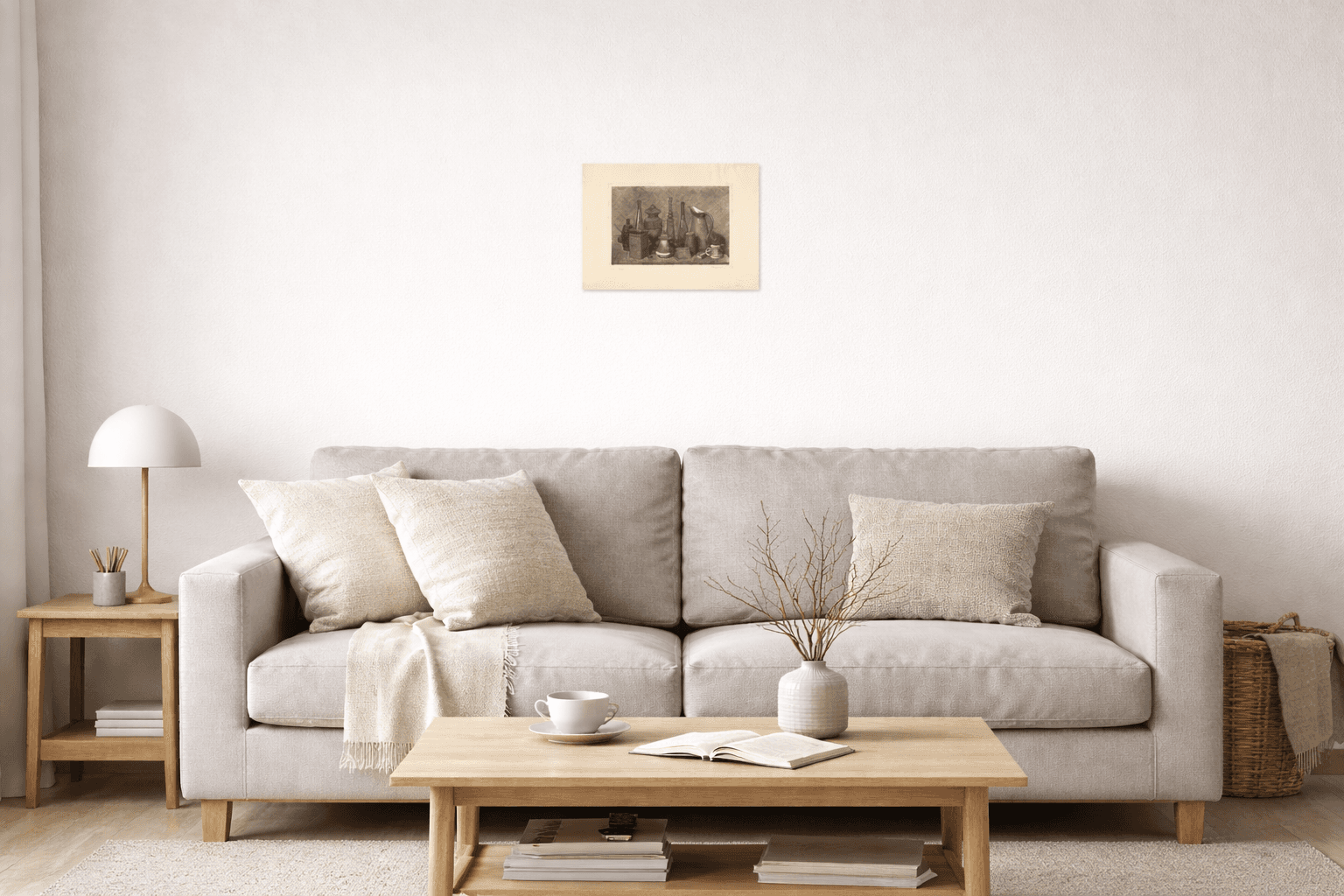
A friend of mine bought a painting in Copenhagen last year. Small gallery in Nørrebro. We were there together - late afternoon light, jazz playing from somewhere in the back. The piece was a deep ocean blue abstract, maybe 80 × 60 cm. She loved it. She could already see it above her sofa.
Two weeks later, it arrived. She unwrapped it, held it up to the wall, and her stomach dropped.
She sent me a picture of it hanging above the sofa, and I immediatly knew what she meant. It was too small. Or the wall was too big. Or something was just... off. The blue that had felt vast and immersive in the gallery now looked like a postcard stuck to a football pitch. She still owns it. It's in the hallway now, where the wall is narrower. She says she likes it there. I don't entirely believe her.
This happens all the time. And it's not because people have bad taste or don't know what they like. It's because galleries are designed — very deliberately — to make art look its best. Your living room is not.
The gallery trick you don't notice
Galleries control everything. Wall colour (almost always white or light grey, chosen to make colours pop). Lighting (spotlit from above at a precise angle, eliminating glare and casting no competing shadows). Spacing (each piece gets a generous halo of empty wall around it, so your eye has nowhere else to go). Ceiling height (typically 3 to 4 metres, which makes everything feel more important).
Your living room has a KALLAX shelf, a window that washes out half the wall after 3pm, and a radiator in exactly the wrong place.
This isn't a criticism. It's just reality. The context a piece of art sits in changes how it looks, how it feels, and whether it works. Galleries have optimised that context for decades. You're seeing art under studio lighting and calling it natural.
The number that matters most (and nobody checks)
Here's something that surprises people: art dimensions are always listed. Every gallery, every online store, every auction house prints them right there on the label. 80 × 60 cm. 120 × 90 cm. 30 × 40 cm.
And almost nobody actually processes what those numbers mean on their wall.
There's a reason for that. Human beings are remarkably bad at imagining physical scale from numbers alone. Try it now: picture 80 centimetres. Is that the width of your desk? Your TV? Somewhere in between? Most people get it wrong by 20 to 30 per cent, and when that error compounds across two dimensions, the result is a painting that feels like it belongs to a different room.
Giorgio Morandi — the Italian painter famous for his hushed, meditative still lifes — worked on sheets that were often barely 40 × 50 cm, with the image being about the half size of that. The image is therefore smaller than the typical laptop. In the Art Institute of Chicago, a 1950s critic described his compositions as looking like "cathedrals rather than bottles." But take that same painting home and hang it above a 240 cm sofa, and the cathedral becomes a postage stamp.

© 2018 Artists Rights Society (ARS), New York / SIAE, Rome
The opposite problem is just as real. Mark Rothko's Seagram Murals — those enormous, brooding rectangles of maroon and black — were painted at roughly 265 × 290 cm each. Rothko built a scaffold in his studio to match the exact dimensions of the restaurant they were commissioned for. He said his paintings were about "the scale of human feelings." At that size, in the dedicated Rothko Room at the Tate Modern, they envelop you. Visitors describe feeling physically swallowed by the colour.
Scale isn't a detail. It's the whole experience.
Why online art shopping makes this worse
At least in a gallery, the art is physical. You can step back. You can see it next to a doorframe and get a rough sense of proportion. You can hold your arm out and estimate.
Buying online strips away even that much. Every painting on a screen is the same size: the size of your screen. A 30 cm Morandi and a 290 cm Rothko render as identical rectangles on your phone. The only difference is a small line of text that says "30.5 × 35.2 cm" — which, as we've established, your brain will cheerfully ignore.
This is the core problem with buying art you haven't seen in person. Not that the quality is uncertain, or the colours might be off (though both are real concerns). It's that you fundamentally don't know what you're getting in the one dimension that matters most: how it relates to your physical space.
And the data backs this up. Online purchases are returned at roughly three times the rate of in-store ones. For art and home décor specifically, a major driver is the item not fitting the space or looking different than expected. Art isn't a pair of jeans — you can't try a different size. If it's wrong, it's wrong.
The tape-measure test (and why it's not enough)
The advice you'll hear most often is: "Tape the dimensions on your wall before you buy." Cut a piece of newspaper or masking tape to the exact size, stick it up there, and see how it feels.
It's decent advice. It's better than nothing. But it still only solves half the problem.
Tape tells you about size. It doesn't tell you about the artwork itself — how the colours interact with your wall colour, how the composition sits against your furniture, whether the piece feels heavy or light in that specific spot. A rectangle of masking tape and a painting are not the same thing, and your brain knows it.
What you really need is to see the actual artwork, at actual size, on your actual wall. Not a jpeg on your phone. Not a tape outline. The real thing, in real proportions, in the space where you'll live with it.
That used to be impossible without buying it first (or borrowing it, if your gallery is unusually generous). It's not anymore. Tools exist now that let you preview artwork on your wall at true scale, right from your phone — no app download, no special equipment, just a link you open and point at the wall. (We built one. It's called Blenda.)
Why galleries should care about this too
If you run a gallery or sell art online, this isn't just a buyer problem. It's your problem.
Every painting that gets returned costs you shipping, handling, time, and — worst of all — a buyer who just had a disappointing experience with art. That buyer is less likely to purchase again. Not because the art was bad, but because the gap between expectation and reality was too wide.
The most common reason someone doesn't buy art online isn't price. It's uncertainty. "Will it actually look good in my space?" If you can answer that question before the sale, you've removed the biggest barrier between someone falling in love with a piece and actually owning it.
Some galleries are figuring this out. They're giving buyers a way to see the art on their own walls before committing — and the ones doing it report that those buyers commit faster and return less. Which makes sense. Confidence drives decisions. Uncertainty kills them.
The space between a gallery and a home
My friend's painting in Copenhagen wasn't a bad purchase. She liked the art. She liked the artist. She just couldn't accurately predict what 80 × 60 cm of deep blue would do on a wall flanked by bookshelves and a window.
That's not a failure of taste. It's a failure of imagination — specifically, the kind of three-dimensional spatial imagination that human brains are simply not wired to do well from memory or from numbers on a label.
The next time you fall in love with a painting — in a gallery, on Instagram, on some artist's website at 1am — don't trust the feeling alone. Trust the feeling and check the fit. Because the art you end up loving most isn't the piece that looked best under gallery spotlights.
It's the one that still looks right six months later, on your wall, in your light, in the life you actually live.
Things people ask
How big should art be above a sofa? The old guideline is two-thirds to three-quarters the width of your sofa. So above a 200 cm sofa, aim for a piece 130–150 cm wide. But rules like this are just starting points — what matters is how it looks from where you actually sit. A 60 cm painting can work above a large sofa if it's part of a grouping. A single 40 cm piece probably won't.
Why does art look bigger in galleries? Three reasons: white walls with no competing furniture, controlled spotlighting that draws your eye to the piece, and generous spacing between works. Your brain assigns importance to whatever dominates your visual field. In a gallery, that's the art. At home, it's competing with everything else in the room.
Can I really tell how art will look on my wall from my phone? Not from a flat jpeg on a screen — your phone renders every painting at phone-screen size, which tells you nothing about scale. But with Blenda, a gallery or artist uploads a regular jpeg and enters the dimensions, and you get a link that lets you see that artwork on your actual wall, at its real size, through your phone's camera. No app to download, nothing to install — just open the link and point. It's not the same as owning it, but it closes most of the gap.
What's the most common mistake when buying art online? Underestimating how much physical scale matters. People focus on subject, style, and colour — which are all important — but then get blindsided when a piece that looked bold on screen turns out to be 30 × 40 cm in real life. Always check the dimensions, and if you can, preview it at real size before you commit.
FAQ
Why does art look different at home than in the gallery?
Galleries are engineered stages: neutral walls, even light around 4000 kelvin, and metres of viewing distance. Your living room has warm bulbs, coloured walls and a sofa two metres away. Same object, completely different performance.
Why does artwork feel smaller or bigger at home than expected?
High ceilings and empty white walls shrink everything, so gallery pieces read smaller than they are. Over your sofa, the same canvas suddenly grows. Scale surprise is the single most common reason bought art disappoints.
How can I check whether an artwork fits my wall before buying?
The manual way: painter's tape in the exact dimensions on the wall, then live with the rectangle for a day. The faster way: some sellers offer a link that shows the artwork at its true size on your wall through your phone camera.