The "I need to see it in person" problem - how online art sellers solve it
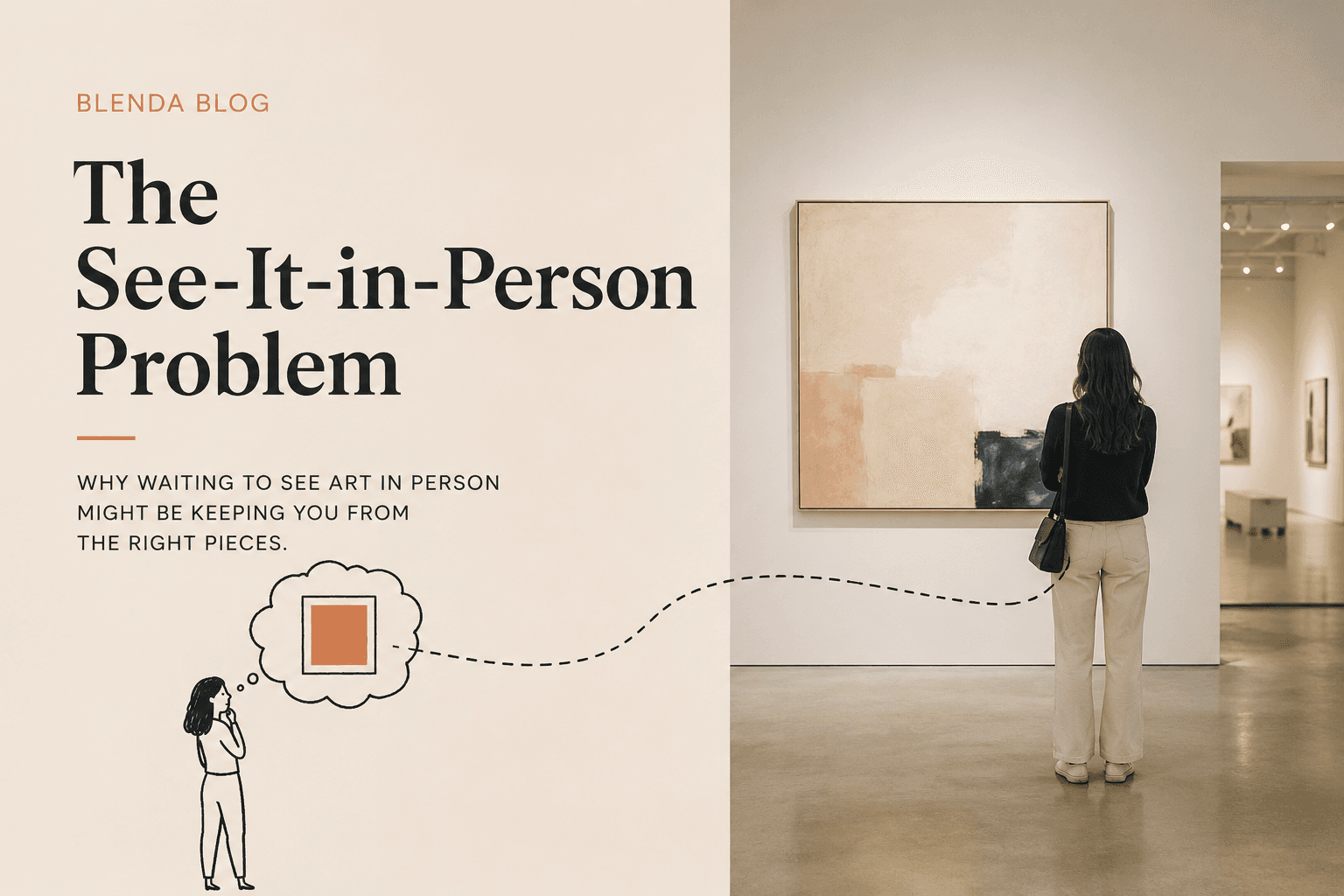
A buyer favorites a piece. They message: "I love it, but I need to see how it looks in my space before I commit." Three days later, the conversation is dead.
This is the most common stall in online art sales. And for years, the standard response was either "we have a return policy" or "here are some photos of it on a wall." Neither worked very well.
Why "I need to see it" is a real objection, not an excuse
People mean it. Looking at a 50 x 70 cm print on a white screen gives no information about how it will feel on a living room wall. The actual problem has three parts: scale, colour accuracy, and whether it will go with what is already there.
Scale is the biggest one. A buyer might know a piece is 80 cm wide, but that number does not translate into feeling until they can see it against their own furniture. Decoration stores figured this out decades ago. Art is catching up slowly.
Colour is the second problem. Screens display colours differently. A print that looks warm and terracotta-toned on one monitor can look pinkish on another. Buyers have been burned before. They know it.
Fit is the third. Someone with a grey sofa and wood floors is asking: "Will this clash?" They cannot answer from a product image alone.
What actually moves the needle
The return policy argument - "just try it, we will take it back" - is weaker than it sounds. Buying something with the intention of returning it feels like homework. Most buyers would rather not commit than deal with the hassle of boxing a print and arranging a courier.
What works is reducing uncertainty before the purchase, not after.
Room mockups done properly. A product image swapped into a realistic-looking room is better than a blank white background. But quality matters. A mockup where the frame is clearly too large for the room, or the perspective does not match the furniture, makes the problem worse. Buyers notice when something looks off, even if they cannot say why.
The key is scale accuracy. If you show a 50 x 70 cm print, it should look like a 50 x 70 cm print in an actual room - not something twice that size. Realistic dimensions, realistic sizes, realistic rooms.

AR viewing. Several platforms now offer augmented reality tools that let buyers hold up their phone and see how a piece looks on their actual wall, at actual size. IKEA proved this model worked at scale in 2017. Art marketplaces adopted it later.
Companies tracking conversion rates consistently report 20-40% higher purchase likelihood from buyers who use AR previews compared to those who only see standard product shots. The effect is particularly strong for large format pieces and for buyers who have never bought art online before.
The barrier to offering this was once high: it required custom app development and expensive rigs. That has changed. Several services now let galleries upload a standard image file and get an AR-ready version back within minutes.
Multiple images from different distances. A single straight-on shot tells a buyer almost nothing about texture, edge finish, or actual physical presence. A close-up of the paper grain, the signature, or the edges of a canvas does real work.
Buyers look at the close-up and imagine holding the piece. That is the mental step that precedes buying.
Size comparison shots. Show the piece next to something the buyer already knows the size of: a door, a piece of furniture, a person. This is simple and almost nobody does it. It costs nothing.
The conversation that closes sales
For pieces above a few hundred euros, some buyers will still want to speak to someone before committing. The worst thing a seller can do at this point is provide more information. The buyer already has information. What they want is reassurance.
The best gallery salespeople do not answer the objection directly. They ask what the buyer is worried about, specifically. Then they address that one thing. "It will clash with my rug" is a different problem from "I do not know if it is big enough" - and each has a specific, satisfying answer.
For online sellers without a sales team, a short video call offer changes the economics. Fifteen minutes on a video call, where the buyer can ask one or two specific questions, converts far better than another email. It sounds time-intensive. Done right, it is not: most calls end in under ten minutes, and the conversion rate is high enough to make it worthwhile.

Photo by Roberto Nickson on Unsplash
What the best online art sellers are doing differently
The galleries and artists converting "I need to see it" buyers at a meaningful rate are not doing anything exotic. They are doing a few basic things consistently:
- Three to five images per listing, including at least one in-room mockup and one close-up
- Accurate dimensions shown visually, not just listed in text
- A clear, low-friction return policy - stated plainly, not buried in a FAQ
- AR viewing for pieces above a certain price threshold
- Fast, personal responses to messages (within a few hours, not a few days)
That last one is underrated. A buyer who gets a thoughtful reply within two hours is a different buyer than one who waits two days. The moment of interest is short.
Blenda builds the room mockup and AR preview steps directly into the listing workflow, so sellers do not need to produce them separately for each piece. But the conversation part - being reachable, being specific, being fast - is still human work.
The honest version of the answer
Some buyers genuinely will not buy online without seeing a piece first. That is a real constraint, not something to be talked around. Gallery shows and local viewings exist precisely because of it.
The goal is not to convert everyone. It is to remove the uncertainty for buyers who want to buy but are not quite ready - and to do it before they find something else.
FAQ
Why do people hesitate to buy art online?
Because a screen shows colour and composition but not scale. A 30x40 print and a 100x140 canvas look identical in a product photo, and few people will pay real money for something they can't place in their own home.
How can customers see art at real size before buying?
Through a link on the product page: it opens the phone camera and shows the artwork on the buyer's own wall at its exact dimensions, in their light, next to their furniture. No app to install.
Does showing art on the buyer's wall reduce returns?
It removes the most expensive surprise: size. Most art returns start with "it looked bigger online", and framed art ships badly in both directions. A true-size preview settles that question before the order, not after.