The Scream is not screaming
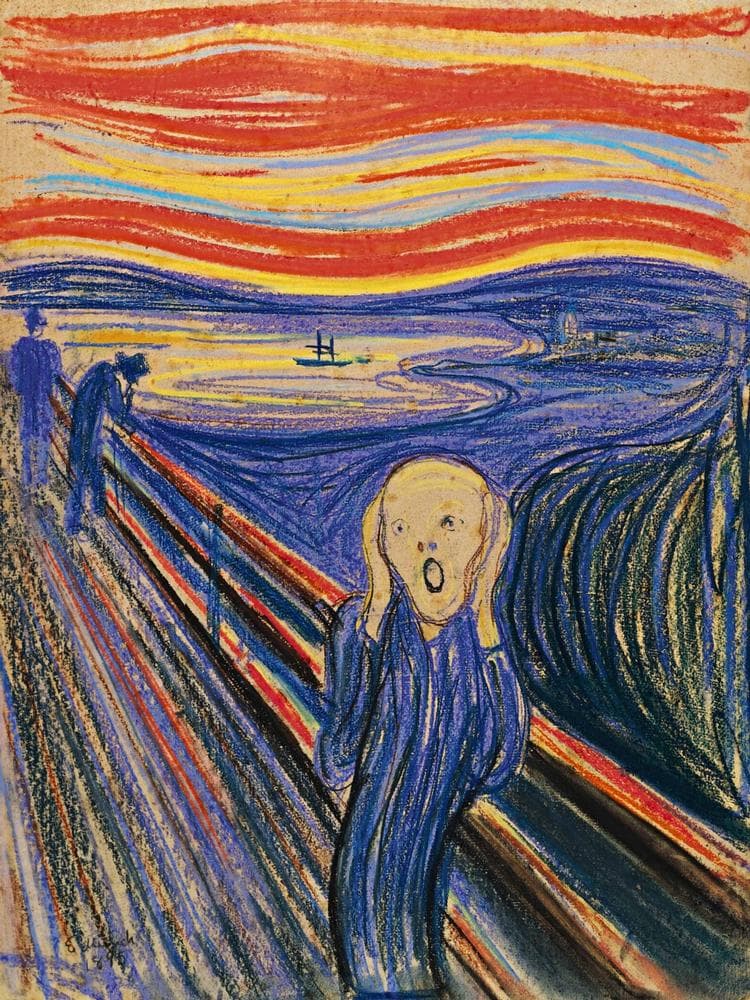
The Figure in The Scream Isn't Screaming
It's easy to miss - the painting is so famous it's become an emoji, a Halloween mask, a meme. But look at the hands. They're pressed flat against the sides of the head, clamped over the ears. The mouth is open, sure. But this isn't someone projecting sound outward. This is someone trying to keep sound out.
Edvard Munch was very specific about what was happening. In a notebook entry dated January 22, 1892, he wrote:
"I was walking along the road with two friends - the sun was setting - suddenly the sky turned blood red - I paused, feeling exhausted, and leaned on the fence - there was blood and tongues of fire above the blue-black fjord and the city. My friends walked on, and I stood there trembling with anxiety - and I sensed an infinite scream passing through nature."
An infinite scream passing through nature. Not coming from the figure. Passing through everything around it. Read that description again, then look at the painting. The hands over the ears tell a completely different story than you assumed.
That's a very different painting than most people think they're looking at.
Smaller than you'd expect
The painting measures 91 × 73.5 cm, roughly the size of a modest coffee table. You could hold it with both hands. That intimacy matters. This isn't a grand statement piece designed to fill a museum wall. It's a private panic attack, rendered on cardboard.
Yes. Cardboard. Not canvas. Not a carefully prepared panel. Munch worked in oil, tempera, and pastel on cardboard - a combination that gives the surface a rough, slightly matte quality. The colours look chalky and feverish rather than rich. The material choice wasn't an accident. Munch often worked on cardboard and unprimed surfaces. Anguish shouldn't look polished.
The Munch Museum in Oslo explains that all versions of The Scream were created on cardboard or paper, making them far more fragile than oil on canvas. The paintings can't be permanently displayed, they're shown on rotation to limit light exposure. There's something fitting about that. The most iconic image of human anxiety is too fragile to be looked at for too long.
The sky that isn't just red
The sky in The Scream isn't a single colour. It's layered in horizontal streaks of orange, yellow, and deep crimson that bleed into each other like a bruise forming in real time. Scholars have debated what inspired it - some pointing to the volcanic eruption of Krakatoa in 1883, which turned sunsets blood-red across the northern hemisphere for months. Others note that nacreous clouds, which occur naturally at Norwegian latitudes, can produce strikingly similar effects.
Below the sky, the fjord sits in an almost nauseating blue-black, completely indifferent to the violence above it. The water doesn't care. The two figures in the background, Munch's friends from that evening walk, don't care either. They're walking away, two dark vertical lines, completely unbothered.
And the figure stands alone. On a bridge, likely near Ekeberg in Oslo overlooking the Oslofjord, everything about its body is wrong on purpose. The face is skull-like, sexless, almost embryonic. The body has no weight. It ripples like the landscape around it, as if the scream moving through nature is dissolving the boundary between human and environment.
That's what Munch nailed about anxiety. It doesn't feel contained inside your body. It feels like the entire world is vibrating at a frequency only you can hear.

The detail most people walk past
Look at the railing on the bridge. It cuts diagonally across the bottom-left of the painting - a hard, straight, geometric line slicing through all those wavy, organic forms. The railing and the bridge are the only straight lines in the entire composition.
The bridge is the man-made world. The rational, structured, built environment. And it's being overwhelmed by the organic, uncontrollable landscape. The straight lines of civilisation versus the curves of nature's scream. The figure stands right at the intersection, caught between both, belonging to neither.
Once you notice this tension between the geometric and the organic, the whole painting reorganises itself. Every element is in conversation with that diagonal line.
"Could only have been painted by a madman"
There's one more thing in this painting that most people never see. In the upper-left corner, in tiny pencil lettering barely visible to the naked eye, someone wrote: "Kan kun være malet af en gal Mand!" - "Could only have been painted by a madman!"
For decades, art historians assumed this was vandalism - a disgruntled critic, a museum visitor with an opinion. But in 2021, the National Museum of Norway confirmed through infrared photography and handwriting analysis that the inscription was written by Munch himself.
The likely trigger: in October 1895, The Scream was shown for the first time in Munch's native Kristiania (now Oslo). The reception was brutal. A medical student named Johan Scharffenberg publicly questioned Munch's sanity at a student debate. Henrik Grosch, then director of the Norwegian Museum of Decorative Arts and Design, wrote that Munch could no longer be considered a serious man with a normal brain.
Munch, whose father and sister both suffered from depression and who would himself be hospitalised after a nervous breakdown in 1908, was deeply wounded. He wrote about that evening repeatedly in his diaries. And at some point, probably shortly after, he picked up a pencil and scratched those words into the corner of his own painting.
Was it bitterness? Irony? Self-awareness? The National Museum's curator Mai Britt Guleng calls it "both a sore and sarcastic comment." Coming from the artist himself, a man who clearly did not believe himself to be mad - it reads as someone seizing control of the narrative. If the world was going to call him crazy for painting what anxiety feels like, he'd beat them to it.
Why it still hits
The Scream has been reproduced so relentlessly: on mugs, phone cases, inflatable costumes that it's easy to forget this is a painting of genuine psychological distress by someone who was genuinely psychologically distressed. Munch wasn't performing. He wasn't being provocative for the sake of it. He was trying to paint what anxiety feels like from the inside, at a time when nobody had a clinical vocabulary for it.
The painting endures because the feeling hasn't gone anywhere. You might not stop on a bridge overlooking a fjord. But you've probably stood somewhere ordinary - a grocery store, a traffic jam, your own ceiling at 2am - and felt something vast and nameless pass through you. Something you couldn't explain to the person next to you, who seemed perfectly fine.
That's the scream. Still passing through nature. Munch just figured out how to make it visible.
Didn't Munch actually paint four versions of The Scream?
He did: two paintings, two pastels, and a lithograph, created between 1893 and 1910. They're all slightly different. The 1895 pastel version sold at Sotheby's in 2012 for nearly $120 million. The 1893 version hangs at the National Museum of Norway in Oslo; the 1910 tempera version rotates through display at the Munch Museum, also in Oslo.
Has The Scream been stolen?
Twice. The National Gallery version was stolen in 1994 on the opening day of the Lillehammer Winter Olympics (the thieves left a note reading "Thanks for the poor security"). The Munch Museum version was taken in an armed robbery in 2004 and recovered in 2006, slightly damaged. The painting apparently inspires strong feelings in criminals too.
Where can you see it in Oslo?
Both the National Museum and the Munch Museum are in central Oslo and both have versions of The Scream. The Munch Museum displays theirs on rotation due to the fragility of the cardboard - so check ahead if you're planning a visit specifically for it.
FAQ
Is the figure in The Scream actually screaming?
No. Munch's own diary note describes walking at sunset and sensing "an infinite scream passing through nature". The figure is pressing its hands over its ears to shut the scream out, not producing it.
How many versions of The Scream exist?
Four: an 1893 painting and an 1893 pastel, an 1895 pastel, and a painting from around 1910, plus a lithograph stone from 1895. Munch returned to the image for nearly two decades.
Where can I see The Scream?
In Oslo. The 1893 painting hangs in the National Museum of Norway, and the Munch Museum holds other versions. The 1895 pastel is privately owned; it sold at auction in 2012 for about 120 million dollars.