The Great Wave off Kanagawa is not about the wave
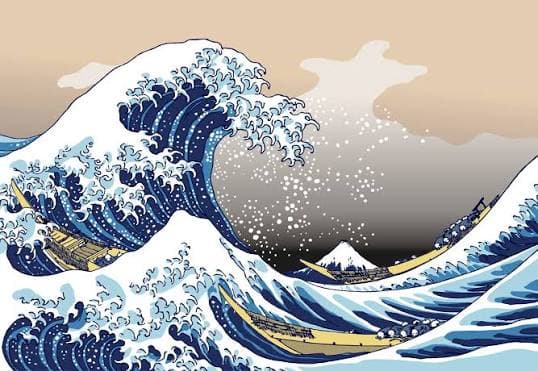
The wave emoji on your phone is a Japanese woodblock print from around 1831. So is a good slice of the merch in every museum gift shop on earth: the umbrellas, the socks, the phone cases, the laptop stickers. Katsushika Hokusai made The Great Wave roughly 190 years ago, and it has since become the most reproduced image in the history of art.
Most people have seen it ten thousand times and looked at it once.
Look again. The wave is not the subject.
The thing almost everyone gets wrong
The Great Wave off Kanagawa (its fuller title is "Under the Wave off Kanagawa," around 1831) belongs to a series Hokusai called Thirty-Six Views of Mount Fuji. The clue is in the name. The real subject is the small, snow-capped mountain sitting calmly in the distance, not the claw of water about to come down on everything.
Find Fuji. It is the pale triangle in the trough of the wave, dead centre, so quiet you keep sliding past it. Hokusai built the entire composition to make you do that, then rewards you the moment you notice. The foam scattering off the wave's crest rhymes with the snow on Fuji's peak. The most violent thing in the picture is pointing straight at the stillest.
It is a print, and there is no "original"
Here is the part that surprises people. There is no single Great Wave hanging in one museum that you could call the original. It is ukiyo-e, a woodblock print, designed to be made in quantity. Carvers cut Hokusai's design into blocks, printers inked them, and thousands of impressions came off the press for ordinary people to buy cheaply.
That is why the Metropolitan Museum of Art has one, the British Museum has one, the Art Institute of Chicago has one, and so does almost every other major collection. They are siblings, not copies. The early, crisp impressions are the prized ones, because the wooden blocks wore down with every pass.
Those early impressions are no longer cheap. In 2023, a fine one sold at Christie's for about 2.76 million dollars, a record for the print. Not bad for a picture that originally cost about the same as a bowl of noodles.

Photo by Christoffer Engström on Unsplash
Why that blue
The colour is doing more work than it looks. The deep, slightly electric blue in the water is Prussian blue, a synthetic pigment newly arriving in Japan through trade when Hokusai made the series. Japanese printmakers had mostly relied on plant-based blues that faded. This one was cheap, intense, and it held.
Hokusai was an early adopter. The Great Wave is, among other things, a showcase for a new material, the way a painter today might lean into a colour their grandparents simply could not buy. The whole series leans blue, and that consistency is part of why it reads as a set.
The detail most people miss: there are people in it
Look into the wave and you will find three boats. They are oshiokuri-bune, fast vessels that ran fresh fish to market, and they are full of rowers hunched flat against the hulls, bracing.
They are tiny. Easy to miss entirely. And that is the drama Hokusai actually built: not a wave in the abstract, but a wave about to break over real working men, with a mountain watching, unmoved, in the background. Once you see the rowers, the picture stops being decorative and starts being frightening.
Hokusai was about seventy, and thought he was just warming up
The man who made the most famous wave in the world was around seventy years old at the time, and nowhere near done. He had already changed his artist name about thirty times and moved house an astonishing number of times across his life. He had survived a stroke. He worked nearly to his death at eighty-eight.
In the postscript to a later book, he wrote one of the great lines about getting older at your craft. By seventy-three, he said, he had begun to grasp the structure of birds and beasts and plants. By eighty he would have made progress. By ninety he would penetrate the meaning of things. And at one hundred and ten, "every dot and every stroke will be as if alive."
He signed parts of that period as "the old man mad about painting." It fits.
Why it conquered Europe
When Japan opened to wider trade in the mid-1800s, prints like this travelled west, often as packing material around more expensive goods. European artists lost their minds over them. The craze got a name, Japonisme. Monet collected Japanese prints and hung them at Giverny. Van Gogh studied and copied them. The composer Claude Debussy kept The Great Wave in view while writing his orchestral piece La Mer, and it ended up on the cover of the 1905 score.
A cheap print made for the Edo public quietly rewired how the West thought a picture could be composed.

Photo by Clay Banks on Unsplash
It is smaller than the poster of it
Here is the fact that reframes everything. The actual print is about 25.7 by 37.8 centimetres. Smaller than most of the posters sold of it. Roughly the size of a sheet of A3 paper.
This is the strange thing about famous images. We meet them at billboard scale, on mugs and murals and screens, and almost never at the size the maker intended. Scale is not a detail. It changes what a picture feels like. A wave that fills a wall reads as spectacle. The same wave at 37 centimetres reads as something you could hold, which is somehow more unsettling, not less.
It is the same gap that trips up anyone buying art online today. A piece looks one way as a thumbnail and another way entirely at its real measurements on your own wall. Seeing it at true size, in your own room, before you commit, is the closest most of us get to standing in front of the real thing. (That gap is exactly what Blenda exists to close.)
So, next time the emoji comes up
You will send it without thinking. A small blue curl of water, two hundred years old, carved into cherry wood by hands whose names we mostly lost.
Look for the mountain. It is still there, in the distance, perfectly calm, waiting for you to finally notice it.
FAQ
Is The Great Wave off Kanagawa a painting?
No, it's a woodblock print from around 1831, part of Hokusai's series Thirty-six Views of Mount Fuji. Thousands of impressions were printed from the carved blocks and sold cheaply, roughly the price of a bowl of noodles.
How big is The Great Wave?
About 25.7 x 37.9 cm, smaller than an A3 sheet. Most people expect a wall-filling painting and are startled by how small the original actually is.
How many original prints of The Great Wave exist?
Nobody knows exactly. Of the thousands printed, surviving impressions are held by museums like the Metropolitan Museum of Art and the British Museum, and their condition varies enormously; early impressions with sharp lines are the prized ones.